

logologo
  • Home
  • Learning Programs
    • Short & Long Courses
    • Online Learning and Product Development
    • Knowledge Platforms
    • Advisory around Capacity Development (CapDev)
    • Training Calendar
  • Scholars & Youth Engagement
    • Degree Program
    • Non-degree Program
    • Scholarships
  • Home
  • Learning Programs
    • Short & Long Courses
    • Online Learning and Product Development
    • Knowledge Platforms
    • Advisory around Capacity Development (CapDev)
    • Training Calendar
  • Scholars & Youth Engagement
    • Degree Program
    • Non-degree Program
    • Scholarships
logologo
  • Home
  • Learning Programs
    • Short & Long Courses
    • Online Learning and Product Development
    • Knowledge Platforms
    • Advisory around Capacity Development (CapDev)
    • Training Calendar
  • Scholars & Youth Engagement
    • Degree Program
    • Non-degree Program
    • Scholarships
  • Home
  • Learning Programs
    • Short & Long Courses
    • Online Learning and Product Development
    • Knowledge Platforms
    • Advisory around Capacity Development (CapDev)
    • Training Calendar
  • Scholars & Youth Engagement
    • Degree Program
    • Non-degree Program
    • Scholarships
July 22, 2026 by irrieducation News & Events 0 comments

IRRI Concludes Second Training Workshop on Self-sufficiency, Food Security and Agricultural Transformation

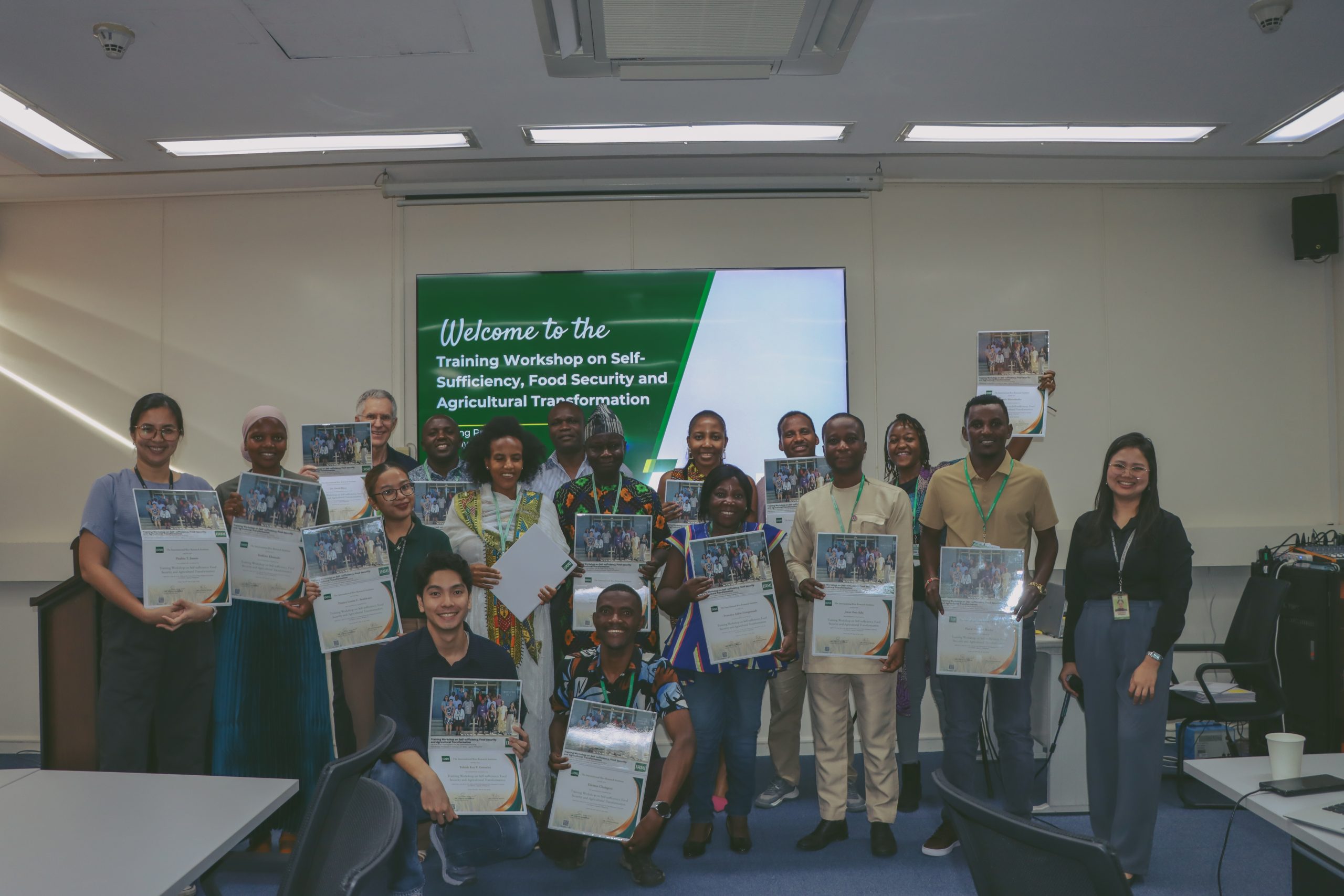
Los Baños, Laguna, Philippines — The International Rice Research Institute (IRRI), through IRRI Education, successfully concluded the second implementation of the Training Workshop on Self-sufficiency, Food Security and Agricultural Transformation, held from 6–9 July 2026 at the MS Swaminathan Building, IRRI Headquarters in Los Baños, Laguna. 

Building on the success of its inaugural offering in 2024, the four-day workshop brought together 15 researchers, policymakers, graduate students, agricultural professionals, and IRRI staff and scholars from Ethiopia, Ghana, Kenya, Nigeria, Rwanda, South Africa, Tanzania, Vietnam, Zimbabwe, and the Philippines. Participants represented national agricultural research institutions, universities, CGIAR centers, and government agencies, creating a diverse learning environment for exchanging experiences on food systems and agricultural development. 

The training aimed to deepen participants’ understanding of the relationships between food security, food self-sufficiency, agricultural transformation, and food trade policies, while equipping them with practical frameworks for analyzing how these concepts influence national development and nutrition outcomes. 
Understanding Food Systems Through Policy and Practice 

Throughout the workshop, participants explored the concepts of agrifood systems transformation, self-sufficiency, food security, agricultural policy, and international food trade through expert-led lectures and interactive discussions. 
Sessions were facilitated by renowned agricultural economists and food policy experts, including Dr. David Dawe, an independent economist specializing in food policy analysis, and Dr. Valerien Pede, Head of IRRI’s Transformative Policies and Investments Unit. Additional lectures from international experts provided participants with broader perspectives on nutrition security, agricultural innovation, and the evolving role of agriculture in sustainable development. 

The program also featured educational visits to several of IRRI’s research facilities, including the Grain Quality and Nutrition Laboratory, Plant Growth Facility, Speed Breeding Facility, and the International Genebank. These visits allowed participants to observe firsthand how research and innovation contribute to improving food systems and supporting global food security. Participants also visited Heager’s Hut and Villa Escudero to gain practical insights into agricultural innovation, enterprise, and the broader social and cultural dimensions of agricultural transformation. 

Learning Beyond the Linear: Collaboration Across Diverse Contexts 


One of the defining features of this year’s workshop was its strong emphasis on collaborative learning. 
Beyond lectures, participants actively engaged in breakout sessions, country exercises, and group presentations where they examined food security and self-sufficiency challenges in the situation of their own countries. Working alongside peers from different regions allowed participants to compare experiences, discuss policy approaches, and collectively develop recommendations grounded in diverse national contexts. 

Rather than learning solely from the resource persons, participants also learned from one another by sharing the realities, opportunities, and challenges faced in their respective countries. The exchange of perspectives enriched discussions and encouraged participants to think beyond local contexts toward regional and global solutions for food systems transformation. 

Participants recognized the value of this collaborative approach. One said that: 

“This training is very rich in knowledge exchange from various participants sharing the information and status of their country.” 

Another participant reflected on how the workshop strengthened their understanding of the interconnected nature of food systems. 

“The course has helped me to make linkages among diverse indicators, production, agriculture share of GDP, employment, self-sufficiency, affordability of a healthy diet, diet quality and nutrition outcomes.” 

Several participants also highlighted how the course broadened their perspectives on agricultural research and policy. 

“This workshop has transformed the way I approach agricultural research. Beyond developing improved crop varieties, I now appreciate the importance of linking research outcomes with national indicators such as poverty, malnutrition, obesity, healthy diet affordability, and agriculture’s contribution to GDP.”


Strengthening Global Capacity for Food Systems Transformation 

The workshop concluded with participant group presentations, reflections, testimonials, and the awarding of certificates, highlighting four days of intensive learning and international collaboration. 

By bringing together participants from across Africa and Asia, the second Training Workshop on Self-sufficiency, Food Security and Agricultural Transformation provided a platform for exchanging knowledge, fostering international collaboration, and strengthening capacities to address increasingly complex food systems challenges. 

Through expert instruction, experiential learning, and meaningful peer-to-peer engagement, IRRI Education continues to equip agricultural professionals with the knowledge and networks needed to contribute to more resilient, inclusive, and sustainable agrifood systems worldwide.


Interested in similar training opportunities? Visit education.irri.org to learn more or email us at irri-education@cgiar.org.

agricultural development capacity building IRRI training
0
IRRI Concludes Hands-On Training Course on Rice Root Phenotyping for Global ResearchersPrevious Post

SIGN UP FOR NEWSLETTER

Receive our latest updates

/* real people should not fill this in and expect good things - do not remove this or risk form bot signups */

CONTACTS

IRRI HQ Location:
Los Baños, Laguna 4031, Philippines
Phone: +63 2 8580 5600, +63 2 8845 0563;
ISARC Office Location:
NSRTC Campus, G. T. Road, Collectry Farm, P.O. Industrial Estate, Varanasi-221006, Uttar Pradesh, India
Phone: +91-0542-2518901, +91-0542-2518900
Email: irri-education@cgiar.org

KNOWLEDGE HUBS

IRRI
CGIAR
Openlearning
Rice Knowledge Bank
CGIAR’s Gender, Diversity and Inclusion Knowledge Hub

QUICK LINKS

  • About Us
  • News & Events
  • Guestbook
  • FAQs
  • Institutional CapDev Facilities

Engage with Us


IRRI-CGIAR logo

Privacy & CookiesLegal NoticeCreative Commons© 2022 IRRI Education. All Rights Reserved

  • Login
Forgot Password?
Lost your password? Please enter your username or email address. You will receive a link to create a new password via email.
Please enter a new password
body::-webkit-scrollbar { width: 7px; } body::-webkit-scrollbar-track { border-radius: 10px; background: #f0f0f0; } body::-webkit-scrollbar-thumb { border-radius: 50px; background: #dfdbdb }

    We would like to hear from you!