

logologo
  • Home
  • Learning Programs
    • Short & Long Courses
    • Online Learning and Product Development
    • Knowledge Platforms
    • Advisory around Capacity Development (CapDev)
    • Training Calendar
  • Scholars & Youth Engagement
    • Degree Program
    • Non-degree Program
    • Scholarships
  • Home
  • Learning Programs
    • Short & Long Courses
    • Online Learning and Product Development
    • Knowledge Platforms
    • Advisory around Capacity Development (CapDev)
    • Training Calendar
  • Scholars & Youth Engagement
    • Degree Program
    • Non-degree Program
    • Scholarships
logologo
  • Home
  • Learning Programs
    • Short & Long Courses
    • Online Learning and Product Development
    • Knowledge Platforms
    • Advisory around Capacity Development (CapDev)
    • Training Calendar
  • Scholars & Youth Engagement
    • Degree Program
    • Non-degree Program
    • Scholarships
  • Home
  • Learning Programs
    • Short & Long Courses
    • Online Learning and Product Development
    • Knowledge Platforms
    • Advisory around Capacity Development (CapDev)
    • Training Calendar
  • Scholars & Youth Engagement
    • Degree Program
    • Non-degree Program
    • Scholarships
May 1, 2026 by cedric gotera News & Events 0 comments

From Innovation to Impact: Strengthening Scaling Pathways for Philippine Agriculture

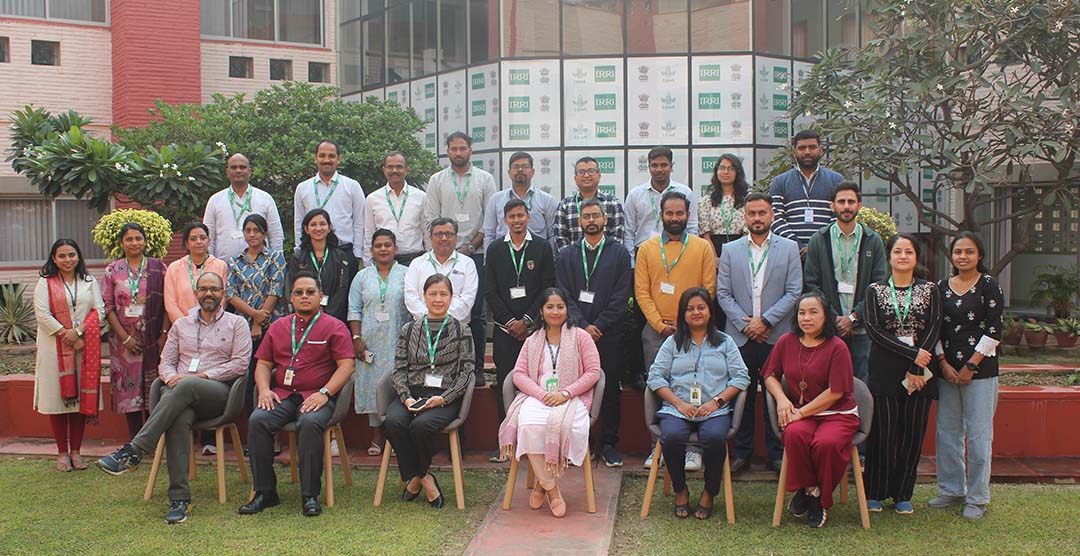
LOS BAÑOS, Philippines — The International Rice Research Institute (IRRI), through IRRI Education, trained 19 participants from the Department of Agriculture – Bureau of Agricultural Research (DA-BAR), Department of Agriculture – Bureau of Plant Industry (DA-BPI), and Department of Agriculture -Bureau of Animal Industry (DA-BAI) on advancing innovation scaling strategies during a three-day course held on 21–23 April 2026 at the IRRI Headquarters, Los Banos, Laguna, Philippines. The training aimed to strengthen capacities in designing, implementing, and assessing scaling efforts to ensure agricultural innovations reach more farmers and generate lasting impact. 

At the International Rice Research Institute (IRRI), the challenge is not only to develop innovations—but to ensure these innovations reach farmers, create impact, and change the system that hinders the improvement of the quality of living of the farmers. 

This was the driving focus of the Project UPSKILL training course on the “Introduction to Frameworks, Approaches, and Tools to Support the Co-Design and Implementation of Scaling Efforts” which was co-supported by the CGIAR Scaling for Impact Science Program. This is the second batch of this training series. 

Bridging the Gap Between Research and Real-World Impact 

In the Philippines, where agriculture remains central to livelihoods in rural areas, the gap between research outputs and farmer adoption can mean the difference between promising solutions and missed opportunities. 

In the opening program, Mr. Joell H. Lales, OIC Director of the Department of Agriculture – Bureau of Agricultural Research, grounded the training in the realities of Philippine agricultural development, emphasizing the need to move beyond generating research outputs toward ensuring that innovations are actually adopted, sustained, and beneficial to farmers and other end users. His message underscored a persistent challenge in the sector: promising technologies often remain underutilized when scaling pathways are not intentionally designed. 

Setting the stage for the three-day training, Dr. Madonna Casimero, lead of Project UPSKILL, provided participants with a course overview, highlighting the importance of building capacities not only in innovation development, but also in strategic scaling. Before diving into tools and approaches, Dr. Rica Joy Flor clarified a critical misconception where scaling is often solely about reaching greater numbers of end users. Instead, she unpacked the idea of systemic transformation through the interconnected concepts of Scaling Out, Scaling Up, and Scaling Deep. Through this, participants understand that effective scaling involves systems transformation, policy and institutional alignment, and shifts in behaviors, mindsets, and practices. Participants further explored how scaling can be made more deliberate and strategic, through key approaches such as Participatory Impact Pathway Analysis (PIPA), Innovation Systems Analysis, and Innovation Packaging and Scaling Readiness (IPSR). This enabled them to rethink how innovations can move from pilot initiatives to co-designed scaling strategies and more deliberate and strategic scaling. 

To translate concepts into action, Mr. Benedict Jardinero facilitated the exercise on developing scaling ambition statements, guiding participants in defining clear long-term impact goals for selected innovations. Meanwhile, Ms. Rowena Castillo and Ms. Abigail Elmido-Mabilangan deepened participants’ understanding of innovation packaging and scaling readiness, equipping them with practical frameworks for identifying bottlenecks, assessing enabling conditions, and strengthening pathways for scaling agricultural innovations. 

One participant reflected on how their organization already works with technological readiness evaluations, but IPSR helps to examine both innovation readiness and innovation use: 

“The IPSR [Innovation packages and Scaling Readiness] training was highly practical and insightful, especially in shifting the focus from technology readiness to scaling readiness… addressing the gap between research outputs and utilization.” 

Beyond the Linear Transfer of Knowledge: Co-Designing for Scaling 

Far from being purely theoretical, the training emphasized hands-on, collaborative learning. Shifting from traditional training formats where knowledge flows in one direction—from speaker to participant—this course intentionally shifted the learning dynamic toward peer-to-peer exchange and co-creation. In addition, participants worked in groups to analyze real innovations, identify bottlenecks, and co-design scaling strategies tailored to Philippine agricultural systems. 

Participants were not only learners but also facilitators of the process, taking turns leading key exercises. In the Participatory Impact Pathway Analysis (PIPA) sessions, one group facilitated stakeholder mapping while another engaged as participants, before switching roles to guide causal chain development. A similar structure was applied in the Innovation Packaging and Scaling Readiness (IPSR) sessions, where groups alternated in facilitating discussions on bottlenecks, solutions, and scaling readiness. They mapped stakeholders, traced impact pathways, and assessed readiness—experiencing firsthand the complexity of scaling in real-world contexts. 

This approach transformed the training into a shared learning space, where participants learned not just from resource persons, but from each other’s experiences, perspectives, and institutional contexts. It also strengthened facilitation skills—an essential competency for scaling efforts that require multi-stakeholder engagement. 

For many, this practical approach revealed why some innovations fail to take off: 

“It highlights the gaps why some of our innovations were stuck and it helps to identify solutions to that… ensuring that innovations are used by our target users.” 

Rethinking Success: From Outputs to Outcomes 

A key insight that emerged from the training was the need to move beyond traditional measures of success. Rather than focusing solely on outputs, participants were challenged to think in terms of long-term impact and sustained adoption. 

As one participant strongly emphasized: 

“We need to move away from shelved outputs but actually generate something useful for our farmers.” 

This realization underscores a broader shift in Philippine agricultural development—toward more intentional, demand-driven, and impact-oriented Research for Development (R4D). 

Building Capacity for Lasting Change 

The training not only strengthened technical knowledge but also built confidence among participants to apply scaling frameworks in their respective programs. With representation from various units of DA-BAR, the learning is expected to ripple outward—informing planning, evaluation, and implementation of agricultural initiatives nationwide. 

Participants described the course as engaging, practical, and directly relevant to their work, highlighting the value of interactive exercises and peer learning. 

From Learning to Action: A Commitment to Scale 

As the Philippines continues to navigate challenges in food security, climate resilience, and rural development, the ability to scale innovations effectively becomes increasingly critical. 

To ensure that learning translates into action, participants from different DA agencies and units within DA-BAR developed individual Learning Action Plans at the end of the course. These plans outline how they intend to apply scaling frameworks and tools in their respective roles and programs—and are to be reviewed and signed by their supervisors, reinforcing accountability and institutional support. 

Through this commitment, the training goes beyond knowledge transfer, serving as a catalyst for real change in how innovations are designed, assessed, and scaled. 

Because ultimately, scaling is not just about reaching more people—it is about improving lives, strengthening systems, and delivering impact where it matters most—especially for Filipino farmers. 

Interested in similar training opportunities? Visit education.irri.org to learn more or email us at irri-education@cgiar.org.

agricultural development capacity building IRRI training
0
India Hosts Advanced Training on Genomic Predictions to Boost Rice BreedingPrevious Post
IRRI Concludes Hands-On Training Course on Rice Root Phenotyping for Global ResearchersNext Post

SIGN UP FOR NEWSLETTER

Receive our latest updates

/* real people should not fill this in and expect good things - do not remove this or risk form bot signups */

CONTACTS

IRRI HQ Location:
Los Baños, Laguna 4031, Philippines
Phone: +63 2 8580 5600, +63 2 8845 0563;
ISARC Office Location:
NSRTC Campus, G. T. Road, Collectry Farm, P.O. Industrial Estate, Varanasi-221006, Uttar Pradesh, India
Phone: +91-0542-2518901, +91-0542-2518900
Email: irri-education@cgiar.org

KNOWLEDGE HUBS

IRRI
CGIAR
Openlearning
Rice Knowledge Bank
CGIAR’s Gender, Diversity and Inclusion Knowledge Hub

QUICK LINKS

  • About Us
  • News & Events
  • Guestbook
  • FAQs
  • Institutional CapDev Facilities

Engage with Us


IRRI-CGIAR logo

Privacy & CookiesLegal NoticeCreative Commons© 2022 IRRI Education. All Rights Reserved

  • Login
Forgot Password?
Lost your password? Please enter your username or email address. You will receive a link to create a new password via email.
Please enter a new password
body::-webkit-scrollbar { width: 7px; } body::-webkit-scrollbar-track { border-radius: 10px; background: #f0f0f0; } body::-webkit-scrollbar-thumb { border-radius: 50px; background: #dfdbdb }

    We would like to hear from you!