
logologo
  • Home
  • Learning Programs
    • Short & Long Courses
    • Online Learning and Product Development
    • Knowledge Platforms
    • Advisory around Capacity Development (CapDev)
    • Training Calendar
  • Scholars & Youth Engagement
    • Degree Program
    • Non-degree Program
    • Scholarships
  • Home
  • Learning Programs
    • Short & Long Courses
    • Online Learning and Product Development
    • Knowledge Platforms
    • Advisory around Capacity Development (CapDev)
    • Training Calendar
  • Scholars & Youth Engagement
    • Degree Program
    • Non-degree Program
    • Scholarships
logologo
  • Home
  • Learning Programs
    • Short & Long Courses
    • Online Learning and Product Development
    • Knowledge Platforms
    • Advisory around Capacity Development (CapDev)
    • Training Calendar
  • Scholars & Youth Engagement
    • Degree Program
    • Non-degree Program
    • Scholarships
  • Home
  • Learning Programs
    • Short & Long Courses
    • Online Learning and Product Development
    • Knowledge Platforms
    • Advisory around Capacity Development (CapDev)
    • Training Calendar
  • Scholars & Youth Engagement
    • Degree Program
    • Non-degree Program
    • Scholarships
June 14, 2024 by irrieducation Technology Transfer 0 comments

GHG Emissions in Rice Systems: Basics of Mechanisms and Standards for Measurements

Course Description

Recognizing the potential of rice production for climate change mitigation, rice-producing regions and different public and private enterprises are increasingly investing in the adoption and scaling of low-emission rice production practices. Accurately quantifying the benefits and impacts of these practices relies on robust monitoring, reporting and verification (MRV) systems for greenhouse gas (GHG) emissions. Building capacity for GHG emissions measurement is therefore key to establishing effective MRV systems, from determining credible baselines to measuring and reporting progress achieved through the adoption of mitigation practices. 

Standard practices for GHG emissions measurement and mitigation management are available for rice systems, with several particularly tailored to the Asian context where more than 90% of the world’s rice is produced. Proper implementation of these standards, with careful consideration of the local contexts, is essential to ensure accurate and robust quantification of these benefits, as well as the effective implementation of the mitigation practices. 

This training course is supported by the Ministry of Agriculture, Forestry and Fisheries (MAFF) of Japan. It aims to build the capacity of various actors in the rice sector to measure GHG emissions across different rice ecosystems and management practices. It will cover the current knowledge of the mechanisms and processes driving GHG emissions from rice fields, as well as the principles and approaches for quantifying and reporting emissions under different management scenarios.

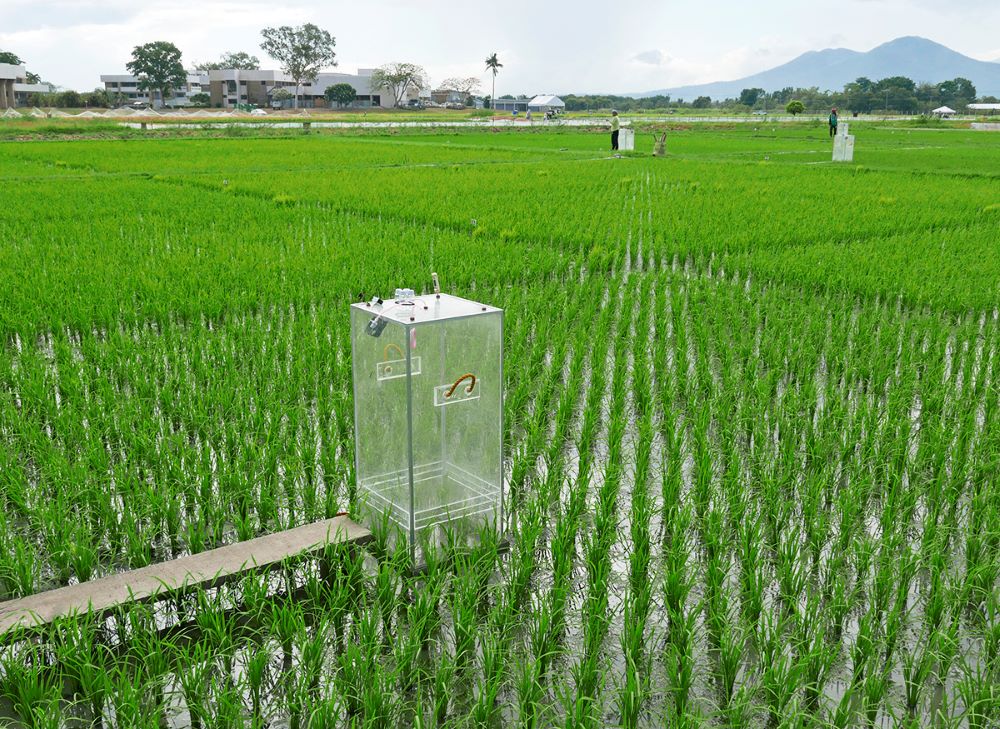
The training comprises a combination of lectures, field demonstrations, and hands-on exercises. It will also provide an overview of the materials and equipment needed for field-based GHG emissions measurements, complemented by practical exercises in different field setups to demonstrate the application of GHG emissions monitoring and reporting approaches. 

Course Objectives

The proposed training course is designed to provide participants with an overview of the significance of climate change and its mitigation in the rice systems; an understanding of GHG emission mechanisms in rice production and the factors influencing emissions, including the impacts of mitigation interventions on system productivity and sustainability; and step-by-step guidance on conducting experimental studies and on-farm monitoring of GHG emissions. The training will cover the entire measurement and reporting process, from developing a project data management and implementing data collection protocols, including gas sampling and laboratory analysis, to data processing, quality control, emissions calculation, and reporting. 

By the end of the training course, the participants should be able to: 

  • Understand the principles of GHG emissions from rice systems and the different management options for climate change mitigation in rice production. 
  • Understand the guiding principles of different approaches to GHG quantification, including the IPCC Guidelines for National GHG Inventories.  
  • Understand the principles of GHG measurement standards applicable to rice systems.   
  • Acquire practical skills in: 
    • GHG sampling in a rice-based system;
    • Data analysis, presentation, and reporting; and
    • Data presentation, interpretation, and reporting 

Key Modules:

  1. Climate change adaptation and mitigation in rice production
  2. Greenhouse gas emission mechanisms and mitigation practices in rice systems  
  3. Global climate mitigation efforts and Monitoring Reporting and Verification Systems for carbon accounting in rice production   
  4. Standards for GHG Measurement in rice systems  
  5. Field setup for GHG monitoring and field sampling procedures 
  6. Gas quantification analytics: Laboratory and in situ approaches 
  7. Data quality assessment and GHG emissions calculations

Learning Modality

The course will be delivered face-to-face through a combination of lectures, hands-on exercises, laboratory analyses, and field-based activities and demonstrations. 

Target Audience

The course is intended for researchers, students, government officers, farmers, agricultural extensionists, rural development officers, and rice carbon project agents. 

GHG Emissions in Rice Systems: Basics of Mechanisms and Standard for Measurements

Course Dates

September 28 to October 1, 2026

Training Duration

Pre-Training Activity: September 24, 2026 | 2:00-4:00 PM Philippine Standard Time (PHT) via Microsoft Teams 
Training Schedule: September 28 to October 1, 2026 | Four days, Philippine Standard Time, Training Rooms 4-6, MS Swaminathan Building, International Rice Research Institute (IRRI), Los Baños, Laguna, Philippines

Deadline of Application

10 September 2026 

Course Fee

External Participants with accommodation - USD 940

The course fee applies to external and non-IRRI participants and includes the training kit, welcome dinner, daily snacks, medical insurance, airport transfers, and accommodation for the duration of the training. In addition, participants are responsible for covering their transportation expenses (including airfare) to and from IRRI as well as their own allowance. 

External Participants without accommodation - USD 572

The course fee applies to external and non-IRRI participants and includes the training kit, welcome dinner, daily snacks, and medical insurance. In addition, participants are responsible for covering their transportation expenses (including airfare and airport transfers) to and from IRRI, as well as their own accommodation and allowance. 

IRRI Staff - USD 374

The course fee applies to IRRI Staff from both Headquarters and Country Offices and covers the training kit, welcome dinner, and daily snacks for the duration of the training. In addition, participants are responsible for covering their transportation expenses (including airfare and airport transfers) to and from IRRI, as well as their accommodation and allowance, which should be charged to their respective bus codes.  

Click here to apply!

Featured Resource Persons

Ando Radanielson (Senior Scientist I – Environmental/Climate Change Expert, International Rice Research Institute)

Dr. Ando Mariot Radanielson is a senior scientist at the International Rice Research Institute with expertise in climate change adaptation and mitigation. She is currently leading a project on reducing methane emissions from rice, the REMET Rice project, aiming to advance the understanding of processes and mechanisms of methane emissions from rice systems to inform the design of low-carbon rice systems with positive outcomes toward sustainability. Ando is a PhD graduate from SupAgro Institute in Montpellier, France in integrative plant biology and an adjunct senior lecturer at the University of Southern Queensland Toowoomba in agricultural systems modeling. She has over a decade of experience in cropping systems modeling and contributed to different advancements of the agricultural system modeling platform APSIM and ORYZA v3 for climate adaptation. Ando has pioneered different initiatives supporting the education of the next generation of agricultural scientists and their access to opportunities for professional and personal growth such as women in STEM mentorship, seed grant programs, student supervision, and crop modeling training programs.

Dr. Kazuki Saito (Senior Scientist II – Cropping Systems Agronomy/Climate Change, International Rice Research Institute)

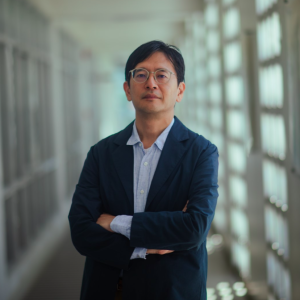
Dr. Kazuki Saito is a Senior Scientist II and Agronomist at the International Rice Research Institute (IRRI), with more than 25 years of experience in rice research across Asia and sub-Saharan Africa. His research focuses on rice agronomy, sustainable intensification, soil and nutrient management, cropping systems, yield-gap analysis, climate-resilient farming, and greenhouse gas mitigation. He currently serves as Lead of Area of Work 4 (AoW4), “Incubating Innovation in Sustainable Farming,” under the CGIAR Sustainable Farming Program, and as Program Director of the ASEAN-CGIAR Innovate for Food and Nutrition Security Regional Program. At IRRI, he also leads the Sustainable Soils sub-unit and major collaborative initiatives with Japan’s Ministry of Agriculture, Forestry and Fisheries (MAFF) on low-carbon and climate-resilient rice systems in ASEAN.
Before joining IRRI in 2023, Dr. Saito spent 17 years at the Africa Rice Center (AfricaRice), where he led rice agronomy research and development activities across sub-Saharan Africa. He previously served as Flagship 3 Leader of the CGIAR Research Program on Rice (RICE) and as a member of the Board of Trustees of the Sustainable Rice Platform (SRP) from 2024 to June 2026.
Dr. Saito has authored or co-authored more than 150 scientific publications. He received the Louis Malassis International Scientific Prize for Young Promising Scientist in 2015. He holds a PhD in Agriculture from Kyoto University, Japan.

Ryan R. Romasanta (Assistant Scientist – Emission Research, International Rice Research Institute)

Ryan R. Romasanta currently serves as an Assistant Scientist at the International Rice Research Institute (IRRI) in College, Laguna, Philippines. Mr. Romasanta has over a decade of experience in emission research. He earned a Master of Science in Environmental Science in 2023 and a Bachelor of Science in Chemistry in 2007 from the University of the Philippines Los Baños.

He specializes in greenhouse gas emissions, with a particular focus on sustainable agriculture and climate change mitigation in rice-based systems. His role includes the technical aspects, overseeing and designing field experiments, collecting and analyzing samples, and evaluating data. He also leads capacity-building initiatives, field demonstrations, and training programs. Mr. Romasanta has served as a resource speaker and trainer at various national and international conferences and workshops, focusing on climate-smart agriculture, greenhouse gas emission measurements, and the operation and maintenance of gas chromatography equipment and laboratory.

Trisha Angela A. Tunguia, RCh (Researcher – Gas Chromatography, International Rice Research Institute)

Trisha Angela A. Tunguia is a Researcher at the International Rice Research Institute (IRRI) with expertise in gas chromatography and analytical chemistry for greenhouse gas (GHG) measurement in rice-based systems. She is part of the Sustainable Impact through Rice-based Systems (SIRS) platform, where she supports laboratory and field-based analysis of gas samples to quantify GHG emissions and ensure compliance with international measurement standards. Trisha is a licensed chemist and holds a Bachelor of Science in Chemistry from the University of the Philippines Los Baños. She has strong technical experience in instrument operation, troubleshooting, and method development, including gas chromatography (GC-ECD), high-performance liquid chromatography (HPLC), and mass spectrometry (MS). Prior to joining IRRI, she worked at the University of the Philippines system, contributing to research projects on proteomics, biochar development, and environmental analysis. 

At IRRI, Trisha plays an important role in capacity-building activities under the AGRI Project, including assisting in the development and delivery of training programs on GHG measurement and gas chromatography. She also supports partners and stakeholders in proper sample collection and data handling, contributing to the generation of reliable, high-quality data for low-carbon and climate-smart rice systems. 

Caesar Arloo R. Centeno (Assistant Scientist – International Rice Research Institute)

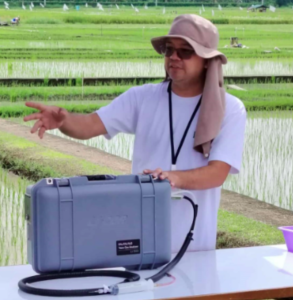
Caesar Arloo R. Centeno is an Assistant Scientist at the International Rice Research Institute (IRRI) with expertise in greenhouse gas (GHG) monitoring, trace gas analysis, weather station management, and agricultural field monitoring using unmanned aerial vehicles (UAVs). He leads field-based GHG sampling operations and conducts on-site gas analysis using laser-based Trace Gas Analyzers (TGA) with automated sampling systems. He also manages weather stations to ensure data quality and reliability, supports collaborative research through GHG sampling and analysis, and utilizes drone technologies for agricultural monitoring and data collection.

7
IPA-IRRI Monitoring & Program Evaluation CoursePrevious Post
Training Workshop on Self-sufficiency, Food Security and Agricultural TransformationNext Post

SIGN UP FOR NEWSLETTER

Receive our latest updates

/* real people should not fill this in and expect good things - do not remove this or risk form bot signups */

CONTACTS

IRRI HQ Location:
Los Baños, Laguna 4031, Philippines
Phone: +63 2 8580 5600, +63 2 8845 0563;
ISARC Office Location:
NSRTC Campus, G. T. Road, Collectry Farm, P.O. Industrial Estate, Varanasi-221006, Uttar Pradesh, India
Phone: +91-0542-2518901, +91-0542-2518900
Email: irri-education@cgiar.org

KNOWLEDGE HUBS

IRRI
CGIAR
Openlearning
Rice Knowledge Bank
CGIAR’s Gender, Diversity and Inclusion Knowledge Hub

QUICK LINKS

  • About Us
  • News & Events
  • Guestbook
  • FAQs
  • Institutional CapDev Facilities

Engage with Us


IRRI-CGIAR logo

Privacy & CookiesLegal NoticeCreative Commons© 2022 IRRI Education. All Rights Reserved

  • Login
Forgot Password?
Lost your password? Please enter your username or email address. You will receive a link to create a new password via email.
Please enter a new password
body::-webkit-scrollbar { width: 7px; } body::-webkit-scrollbar-track { border-radius: 10px; background: #f0f0f0; } body::-webkit-scrollbar-thumb { border-radius: 50px; background: #dfdbdb }

    We would like to hear from you!